
Six chapters. One useful foundation.
The course takes about 18 minutes to read. That is an estimate, not a countdown. You can open any chapter, revisit an explanation, or leave the next question for another day.
- Chapter 1 · About 2 minutes
What are we trying to do?
The aim, the pot and what a hand means.
- Chapter 2 · About 3 minutes
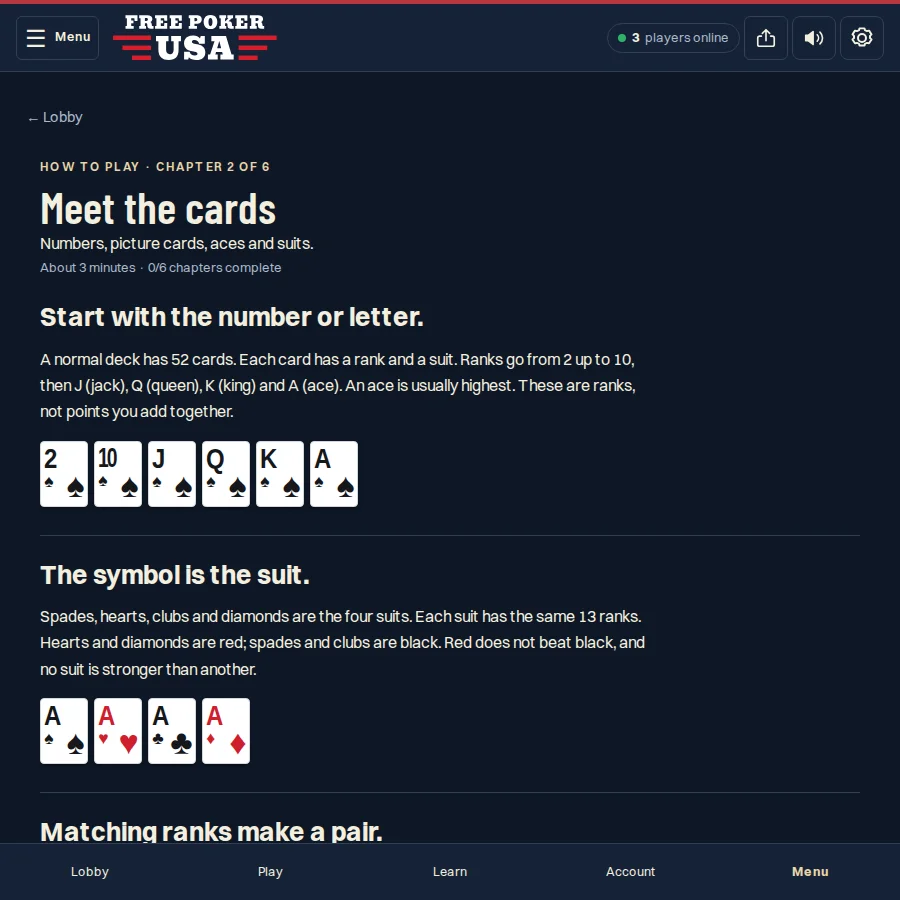
Meet the cards
Numbers, picture cards, aces and suits.
- Chapter 3 · About 3 minutes
Your cards and the shared cards
Two private cards, five shared cards, one best five.
- Chapter 4 · About 4 minutes
Which hand wins?
Pairs, stronger combinations and ties.
- Chapter 5 · About 3 minutes
What can I press?
Check, call, fold, bet, raise and all-in.
- Chapter 6 · About 3 minutes
Follow one complete hand
The dealer, blinds, flop, turn, river and result.
Each chapter ends with a question. A correct answer marks it complete; a wrong answer gives an explanation and another try. Wrong answers do not take chips or erase completed chapters.
Choose the practice that fits
The academy, public puzzles, and visual trainer are different tools. You do not need to finish one before using another.
- Beginner chapters
- Six lessons with personal completion tracking. The chapters do not award chips or game XP.
- Skill circuit
- Nine optional puzzles across three tracks in the academy interface, with practice XP and medals.
- Starter challenges
- Ten hand-identification challenges in the academy interface. Useful after the hand-ranking chapter.
- Public hand puzzles
- Six shareable examples, with no account progress, XP, or leaderboard score attached.
- Visual trainer
- Card-led lessons, exact odds, and river decisions. Practice lasts for that visit and does not change your saved chapters or game XP.
A pair is about rank, not color
These two queens make a pair. Their suits differ, but both cards have the same rank. That is the idea behind the second chapter’s card examples.
A pair of queens
Diamonds and spades are different suits. Neither suit makes this pair stronger or weaker.
When you are ready for more, use the illustrated hand-ranking chart. Then try the kicker puzzle to see why identical pairs do not always mean a split.
What gets saved
The interactive academy records your chapter progress in your current game save. As a guest, access is linked to this browser by a cookie. Signed-in progress belongs to your account. Check the displayed save status before leaving.
When registering a new account, choose the guest-import option if you want to bring that progress with you. Signing into an existing account does not merge a guest save. Clearing cookies or ending a private session can remove access to guest progress.
Finishing all six chapters unlocks a personal completion card. It is not an accredited qualification, verified score, or prize entry. This public overview does not display your private progress.
Use Player account for account controls and the privacy notice for storage details. Keep a private backup code for progress you would not want to lose.
Take the idea to a table
After the basics, try a Hold’em practice table against computer opponents. Pick one small goal, such as checking the amount to call before choosing an action. Winning the next pot is not the test.
Dramaha and Chicago use different rules. Read the Dramaha High guide or Chicago guide before switching games. This academy teaches Texas Hold’em, not every card game in the lobby.
Free single-player practice for adults 18+. No deposits or cash prizes. Your next chapter can wait.