
Five cards. Two separate results.
For draw high, use all five private cards. For Omaha high, use exactly two private cards and exactly three board cards. Both halves use high poker rankings; there is no low-hand half in this version.
Draw half
All five cards in your hand. No shared cards.
½ of the potOmaha half
Exactly two from your hand, plus three from the board.
½ of the potYou can win one half or both. Winning both is often called scooping. If a 120-chip pot has different sole winners, each receives 60 play chips; ties and side pots can change the distribution.
The basic sequence follows the BARGE Dramaha rules. Other games called Dramaha can use different draw limits or low-hand rules. This page describes our High beta, not every variant.
Follow one hand
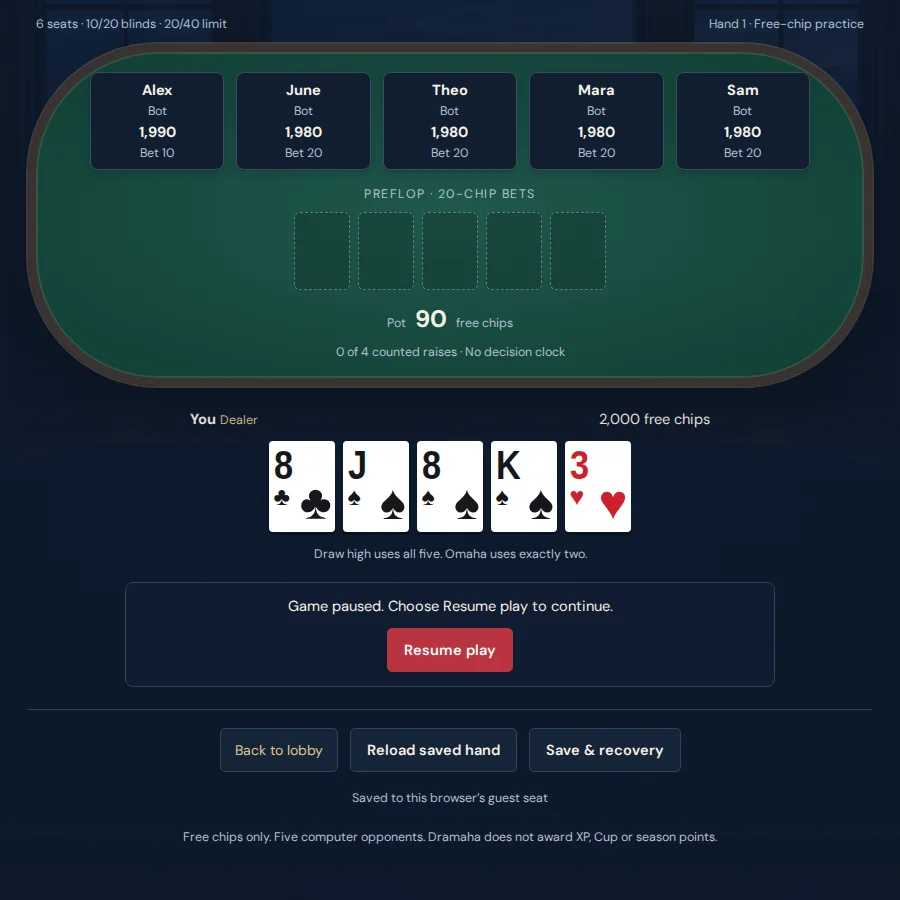
Receive five private cards
The table has six seats: you and five computer opponents. The blinds are 10 and 20 play chips. Pre-flop betting uses a 20-chip fixed-limit unit.
See the flop and bet
Three shared cards appear. Another betting round follows, still using the 20-chip unit.
Choose your draw
After flop betting, each remaining player chooses zero to five private cards to replace. Keeping every card means drawing zero. All-in players still take part in the draw.
See the turn and river
The fourth shared card arrives, followed by betting. Then the fifth arrives, followed by the final betting round. Both rounds use a 40-chip unit.
Compare both hands
If more than one player remains, the game settles the draw and Omaha portions separately. If everyone else folds, the remaining player wins without a showdown.
The same cards can make different hands
Suppose you reach showdown with these private cards and this board. This is a teaching example, not a promise about the next deal.
Your five private cards
Shared cards
Your draw hand: one pair
Your two aces make a pair. The board cannot improve the draw hand.
Your Omaha hand: aces full of kings
Use your two aces with the board’s ace and two kings. That is exactly two private cards and three shared cards, giving you a full house.
Each result must still beat the eligible opponents’ hands for its half. A strong Omaha hand does not automatically win the draw half. Keep the hand-ranking chart nearby if you need it.
The house rules in this beta
Current rules profile: dramaha-high-barge-fl, version 1.0.0. These details belong to this implementation; the BARGE page does not prescribe every betting or odd-chip decision below.
- Draw order: players declare clockwise. Draw counts become public as choices are locked, but replacement cards wait until every remaining player has chosen.
- Betting cap: each round allows four counted raises after the opening bet. The action panel shows what is legal; you do not choose an unrestricted no-limit amount.
- Short all-ins: cumulative increases of at least half the round’s bet unit can reopen betting under this fixed-limit policy. The game applies the cap and each player’s legal actions.
- Odd split chip: the extra chip from splitting an odd pot goes to the draw portion. Remainders within tied portions are distributed clockwise, starting left of the button.
- Separate progress: Dramaha does not award Hold’em XP, Cup points, or season points.
A common mistake is using three private cards for Omaha because they look useful. Count the cards you use: two from your hand, three from the board. Another is planning a draw before remembering that it can change both of your hands.
Take a seat, then check the save status
The beta uses free play chips against computer opponents. It is not real-money poker, multiplayer, or a solved-strategy trainer. No deposit is required, and the chips have no cash value.
Signed-in saves belong to your account; signed-out saves belong to this browser’s guest session. Dramaha has its own saved seat, separate from Hold’em. Use the game’s save and recovery controls, and keep a backup before clearing browser data.
Opening the game does not convert a Hold’em save into Dramaha. Read the storage explanation if you are changing devices or accounts.
Prefer to learn the standard poker actions first? Open the poker academy overview. For a points-and-tricks game instead of a split pot, see Chicago rules.