
Read the value, not just the color
A denomination is the number a chip represents. Four chips worth 25 each add up to 100; four chips worth 5 each add up to 20. Count their combined value, not just the number of discs.
For a physical play-chip game, agree the values before dealing. Colors can vary between sets and games, so a green chip is not a universal promise of a particular value. Pagat’s betting rules describes common denominations and notes that the ratios can be adjusted.
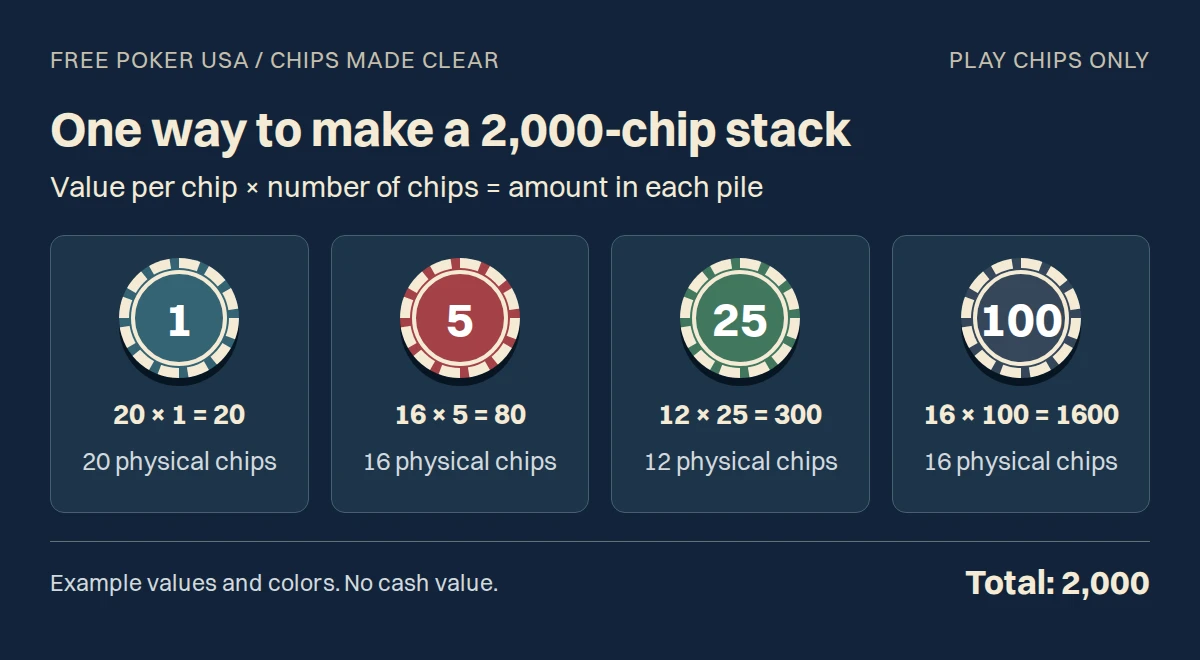
| Value per chip | Number of chips | Combined value |
|---|---|---|
| 1 | 20 | 20 |
| 5 | 16 | 80 |
| 25 | 12 | 300 |
| 100 | 16 | 1,600 |
| Total | 64 chips | 2,000 |
In the browser game, read the displayed stack, pot, and action amounts. You do not need to assemble physical chip stacks or remember a color chart. A decorative pile is not a substitute for the number beside it.
The first 30 chips enter before the cards
Imagine a six-seat Hold’em practice table with blinds of 10 and 20. The small blind posts 10; the big blind posts 20. That puts 30 play chips into the pot before voluntary action begins.
Find the button
With three or more seats, the small blind is immediately clockwise from the dealer button. The big blind is next. The first preflop decision comes from the next active seat.
Read what is already in
If nobody has raised, a player with nothing committed calls 20. The small blind needs only 10 more to reach 20. The big blind can check when the action returns unraised.
Move to the next round
Once betting is complete, the flop brings three shared cards. Contributions stay in the pot, but the new betting round starts with no new bet to match. Later rounds follow the same idea.
These positions and actions follow PokerStars Hold’em rules. Heads-up uses a different blind arrangement: the button posts the small blind and acts first before the flop. Use the six-seat position diagram before trying to memorize seat names.
A call is the difference, not the whole bet
Suppose you posted the 20-chip big blind and another player raised to 60. You have enough chips left for either option. Calling costs 40 more, because your original 20 already counts toward this round.
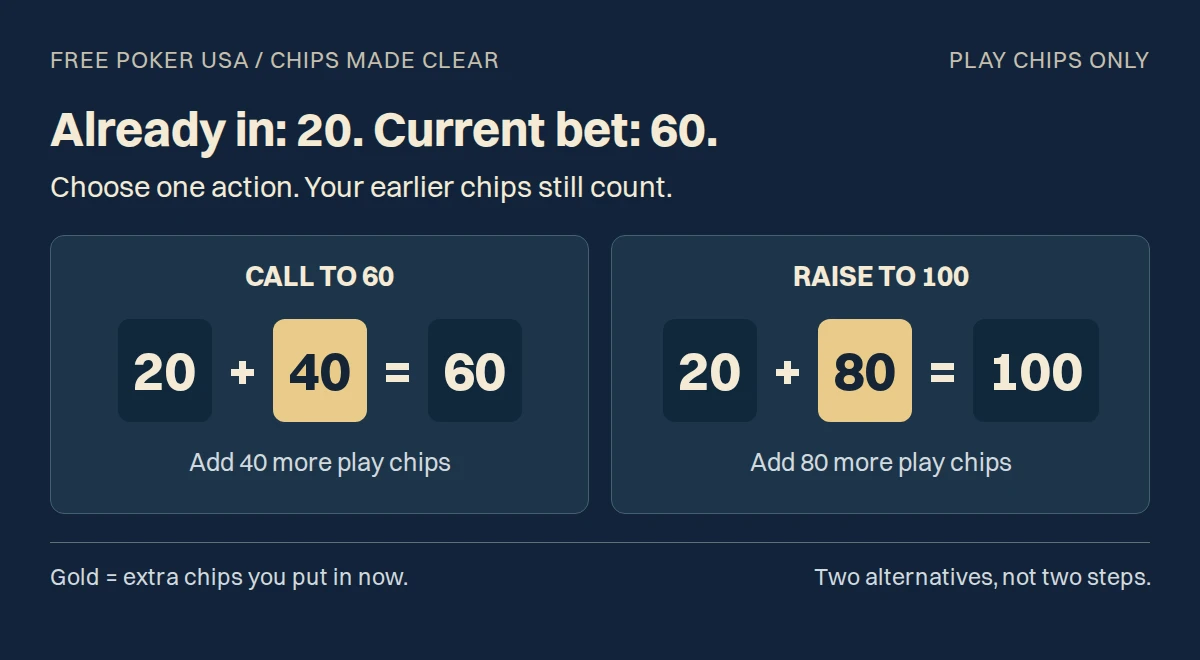
- Call 40
- 20 already in + 40 added = 60 committed this round.
- Raise to 100
- 20 already in + 80 added = 100 committed this round.
- Fold
- Add nothing. Leave the hand, but your committed 20 stays in the pot.
The raise from 20 to 60 was an increase of 40, so the next normal minimum full raise is to 100. That is 60 plus another 40, not an automatic doubling of 60. PokerStars Hold’em rules gives the same minimum-raise principle.
This example does not tell you which action is strategically best. That depends on your cards, position, stack, and the action before you. It teaches the price, which is worth knowing before you decide whether to pay it.
Try the price before you try the hand
ONE SMALL CHECK
You already put in 10. The current bet is 50.
You have enough chips behind. How much more would you add to call: 10, 40, or 50?
Check the answer
40 more. Subtract the 10 already committed this round from the current 50. You finish with 50 in for the round; the 40 is your extra cost.
If you got it wrong, try the subtraction again. Nothing happens to your chips or saved progress here. This is a public example, not a scored lesson or a test with a timer.
A short stack changes what you can add
If the amount you owe is more than your remaining stack, you can put in your remaining chips as an all-in call. You cannot win chips from a side pot you did not contribute to. The eligible players and amounts matter.
A short all-in increase also does not automatically let every earlier player raise again. Those reopening rules depend on the action and full-raise amounts. Read the legal options shown in the game; Pagat’s betting rules explains why incomplete bets need separate treatment.
Do not borrow chips halfway through a hand to cover a call. In this site’s practice formats, a free refill is a separate option when the stack reaches zero. The tournament formats have no rebuys.
Three mix-ups you can leave behind
- Stack versus pot: your stack is still available to you. The pot contains chips already committed by the table.
- Raise to versus raise by: “to 100” is the target total for this round, not 100 extra chips. Read the confirmation amount.
- Winning a pot versus profit: a returned pot can include your own earlier contribution. The full amount received is not always the amount your stack increased by.
Chips tell you the price, not who wins at showdown. Use the hand-ranking chart, then try the kicker example to compare two hands with the same pair.
Take one useful habit to the table
For your next practice hand, read three numbers before acting: your stack, the pot, and the extra cost to call. You do not have to play more hands to make that a useful exercise. One clear decision is a reasonable place to stop.
Follow the beginner path if the cards and controls are both new. The practice guide compares formats, and the academy overview explains the six beginner chapters.
FreePokerUSA.com is single-player entertainment for adults 18+, against computer opponents. There are no deposits or cash prizes, and play chips cannot be withdrawn as money. This guide is not a promise of results in real-money poker.