
Reach 52, with a qualifying Chicago call
Choose two to six total seats. Every seat except yours is a computer opponent. Scores carry between deals, and a normal win requires at least 52 points plus a valid Chicago call made somewhere in the current game.
The call does not have to succeed. Once made, it remains recorded through later deals and point resets. Reaching 52 without that qualification eliminates you, with your recorded score retained. A straight flush has a separate instant-win exception.
This is a house version. Pagat’s Swedish Chicago rules and The Festival’s explanation describe other scoring and procedural choices. Do not assume every Chicago table follows this page.
Three chances to change your hand
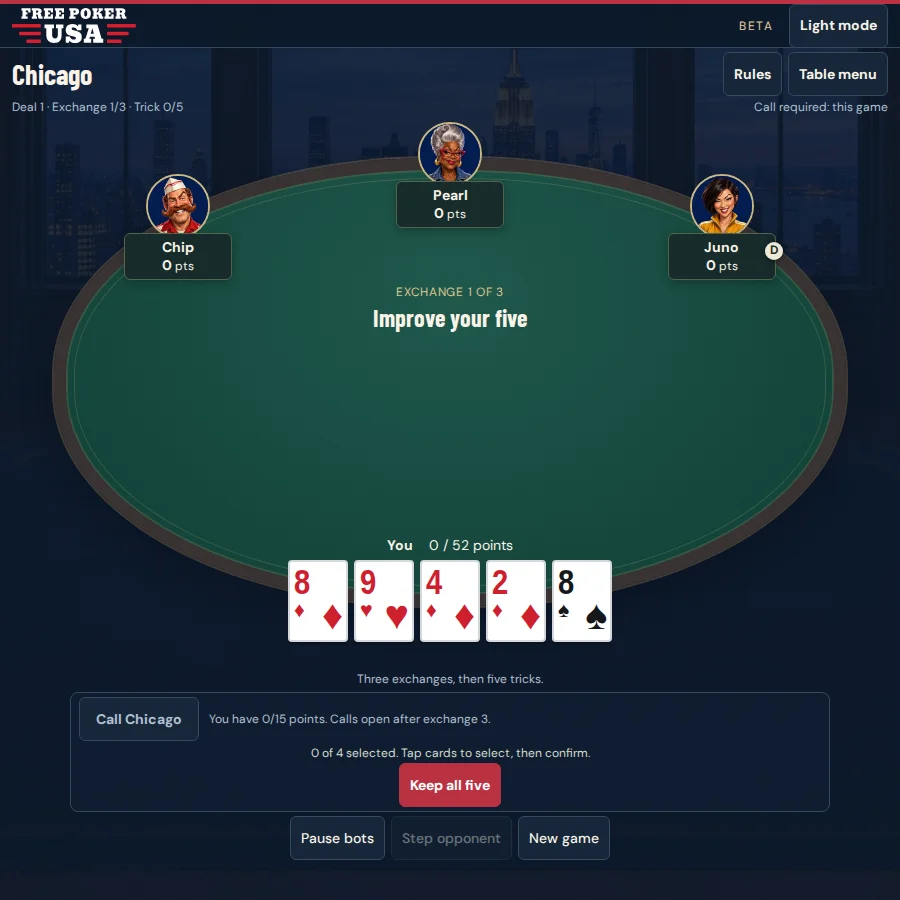
Each active player receives five cards. In each of three exchange stages, keep all five or replace up to four. When you replace exactly one card, you see an open offer: keep it, or decline it for one hidden replacement.
First exchange
After everyone has chosen, the strongest poker hand scores. The game announces the player and hand category without showing everybody’s private cards.
Second exchange
Change cards again, or keep your hand. The strongest hand scores again.
Third exchange
Make the final changes. Eligible players are then asked whether to call Chicago. Without a call, the final poker-hand award waits until after the five tricks.
At 45 points or more, exchanging any cards resets your score to zero. The game asks you to confirm. Keeping all five avoids that reset; a previously recorded qualifying call remains.
How points are awarded
Only the strongest hand receives the poker-hand award at a scoring stage. Holding a pair is not enough if another player holds a better hand. High card alone scores zero.
| Hand or result | Award |
|---|---|
| One pair | 1 point |
| Two pair | 2 points |
| Three of a kind | 3 points |
| Straight | 4 points |
| Flush | 5 points |
| Full house | 6 points |
| Four of a kind | 8 points, or reset active opponents and end the deal |
| Straight flush | Immediate win; winner’s score becomes 52 |
| Royal flush | Immediate win, plus active opponents reset to zero |
| Ordinary last trick | 5 points, or 10 when won with a two |
| Successful Chicago | 15 points, without an extra last-trick or final-hand award |
| Broken Chicago | Caller loses 15; the trick winner who breaks it gains 10 |
Scores never fall below zero. For example, an uncontested best pair can score 1 in each of the first two stages. Without a Chicago call, winning the last trick normally adds 5; a final best pair can add another 1, provided the game has not already ended.
Follow suit. There are no trumps.
A trick is one card from each active player. If you hold the suit that was led, you must play it. If you cannot follow suit, you may play any card, but an off-suit card cannot win that trick.
Hearts were led
The king of hearts wins this trick. The ace of spades is higher in rank, but it is not a heart. That ace is only a legal play here if its player has no hearts left.
The highest card in the led suit wins and leads the next trick. Without Chicago, the first active player left of the dealer leads first. The first four tricks have no ordinary trick-point award; the last trick matters.
Poker-hand points and trick winners are different comparisons. A strong poker combination does not automatically win all five tricks.
What calling Chicago commits you to
After the third exchange, players with at least 15 points are asked clockwise from the dealer’s left. The first player to say yes becomes the only caller and leads the first trick. Calling means trying to win all five tricks.
- Win all five: gain 15 points. There is no extra ordinary last-trick bonus or final poker-hand award.
- Lose any trick: lose 15 points. The winner of that completed trick gains 10, and the deal ends immediately.
- Pass: keep your points. A valid call from an earlier deal still counts toward qualification.
In this beta, even an unsuccessful valid call qualifies you for the normal 52-point win condition later in the same game. Starting a new game clears that qualification. A hand that looks good for poker may still be a poor five-trick hand.
Details that differ between versions
Current profile: chicago-gamewide-0.2. These are the implemented choices, not universal Chicago rules.
- Timing: ordinary last-trick points are awarded before the deferred third-stage poker points. The game checks for a winner after each positive award.
- Four of a kind: taking 8 points locks that same combination to points for the rest of the deal. Choosing a reset ends the deal. Third-stage decisions wait until after ordinary tricks and are cancelled by a Chicago call.
- Resets: only active opponents are reset; eliminated players keep their recorded scores.
- Instant wins: the best straight flush wins without a prior Chicago call. Its final score is set to 52; a royal also resets active opponents.
- Ties: all poker kickers count. Exact ordinary ties go to the first tied player clockwise from the dealer’s left. Exact straight-flush ties use hearts, spades, diamonds, then clubs. That suit order does not create trumps.
- Replacement cards: completed earlier discards can be recycled, but your current discards and a declined open offer cannot return during that same exchange.
Try the free beta
Chicago has no stakes, cash prizes, XP, or leaderboard reward. Guest and signed-in games use separate save ownership. Check the game’s save status before leaving, and keep backups private: they contain the deal seed and action history.
The beta is an independent implementation, not an official tournament client. Its personal game is separate from your Hold’em progress. See the privacy and storage notice for account details.
For a different mixed game, read Dramaha High rules. If poker combinations are still new, start with the poker academy. There is no need to learn every game tonight.