
Learn poker by playing five guided hands
Open Learn and choose Play 5 hands. The Welcome Table introduces one short poker idea per hand. You play against bots, with no guaranteed wins.
Choose Explain for an example, or Skip tips to remove the guidance. You decide when to deal again. After five hands, review your results and choose whether to keep playing, try a lesson or stop.
Already started? Choose Continue guided hands or View recap. Your existing game is not replaced without asking. Check the save status before leaving.
Five basics to check before you play
Find your seat and the pot
Open the dealer-button explanation. Learn which cards belong to you, which cards are shared, and where the chip balance and call cost appear.
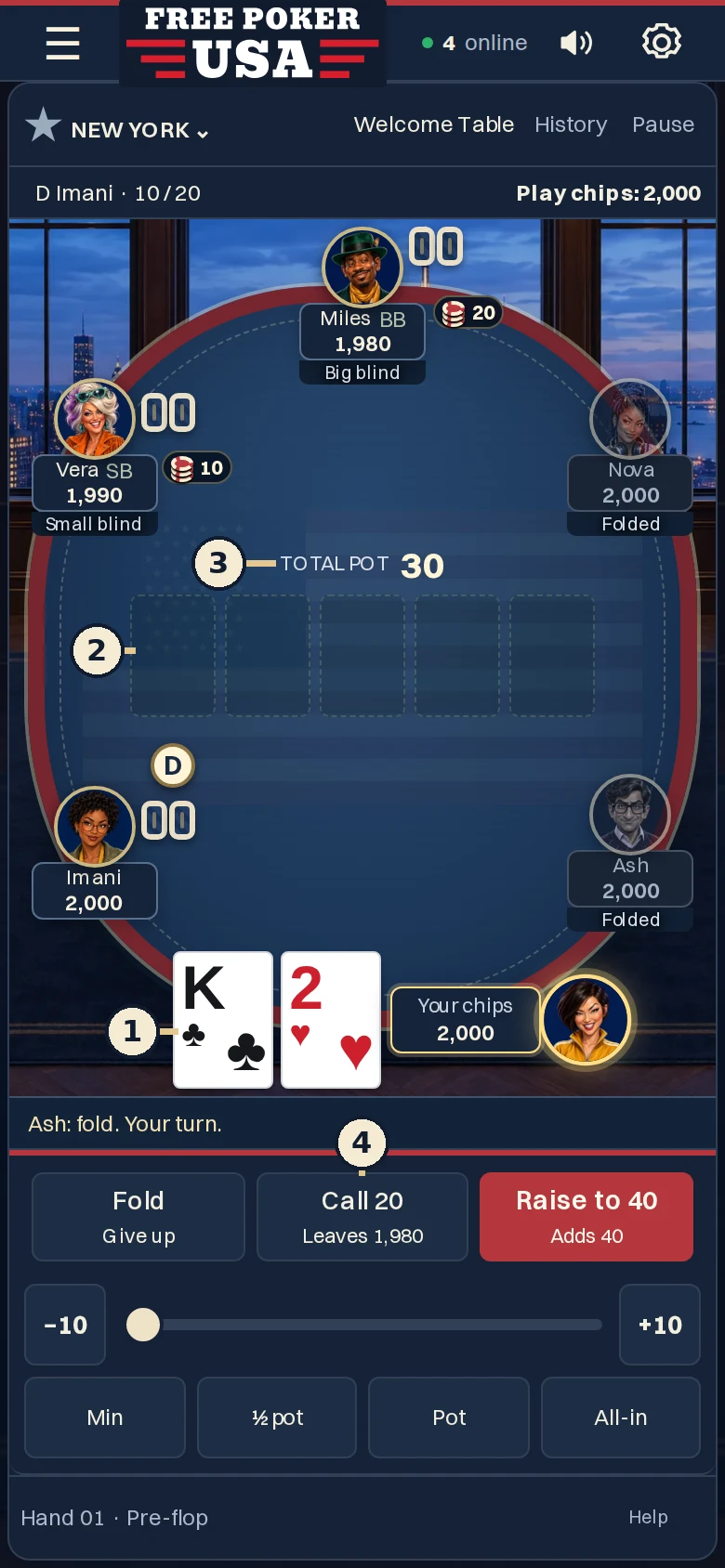
A practice hand in a mobile-sized browser. Cards, chip balances, and action costs vary by hand. - Your cards: the two private cards at your seat.
- Shared cards: the center row, dealt as the hand develops.
- Pot: the total chips committed to the hand.
- Call cost: the extra chips needed to match the current bet.
Recognize the common hands
Start with pair, two pair, three of a kind, straight, and flush. Use the ten-hand trainer; there is no timer and mistakes get an explanation.
Read a call before making it
Try the 40-chip call example. The useful habit is checking what you owe, not tapping the most colorful button.
Compare exactly five cards
Try the board’s royal flush. It explains why someone’s pocket aces can be irrelevant at showdown.
Play one practice hand
Open the free table, then use Move help if a decision is unclear. After the hand, read the result before starting another. Pause whenever you like.
Three habits worth keeping
- Read the board again after every new card. Ask whether a straight, flush, or paired-board hand is now possible.
- Separate a good decision from a won pot. A lucky river doesn’t prove the earlier call was wise, and losing doesn’t automatically make a fold or call wrong.
- Explain the winning five. Use the tiebreaker guide when two hands look similar.
These are practice suggestions, not promises of profit or success in real-money poker. This game is for entertainment and learning.
A few common mix-ups
Do I have to use both of my cards?
No. In Hold’em you may use zero, one, or two hole cards to make the best five (PokerStars Texas Hold’em rules).
Does my ace break a shared straight?
No, if both best hands are the same straight. A five-card straight has no spare place for a kicker (PokerStars hand-ranking rules). Try the shared-straight example.
Should I start with the tournament?
We recommend practice first so you can learn the controls and rebuy from your wallet if you run out. The Cup has rising blinds and no rebuys; read its format when that sounds like a useful next challenge.
Keep learning inside the game
Start with six short beginner chapters in the skill academy. Then try nine practice puzzles across three tracks or ten starter hand challenges. The separate visual trainer does not award game XP.
The Daily Three offers a fresh set at 00:00 UTC with cumulative completion stamps. There is no streak to lose if you take a day off. Come back for a useful exercise, not a deadline.
Try next
A few faces at the table
These are fictional computer opponents, not live players. Open a profile to meet the character and read about their playing tendencies.
 ChipNew York · The curious caller
Calls smaller bets with a wider range. Usually raises for value.
Read Chip's profile → PearlChicago · The patient value player
Selective before the flop, with strong value raises and few bluffs.
Read Pearl's profile → DotChicago · The selective bluff-catcher
Chooses starting hands carefully, but can call a modest river bet with medium strength.
Read Dot's profile →